Conflicts and refusal
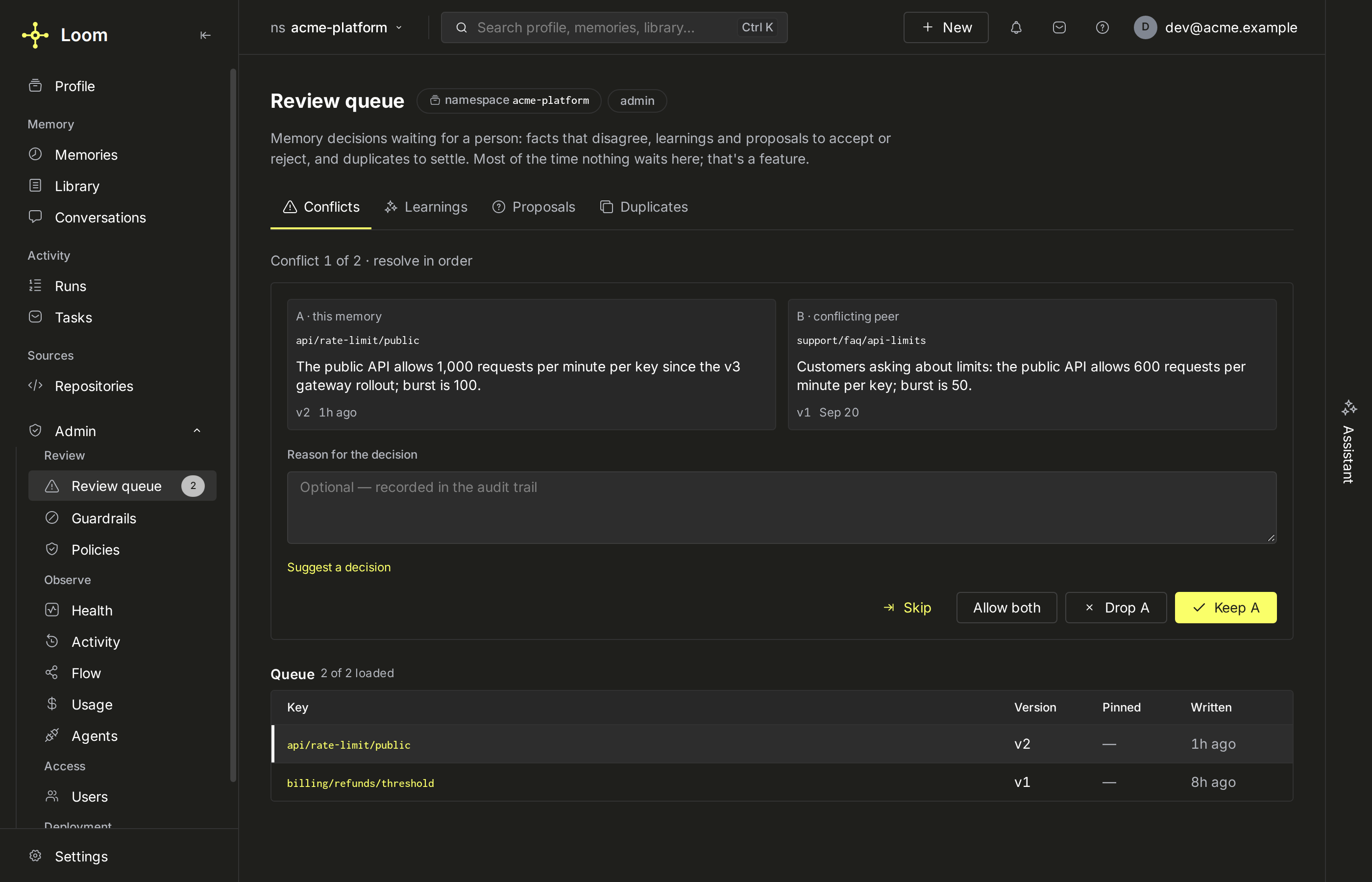
Every memory write is judged against the facts the namespace already holds. A close but
different value is stored and flagged as a conflict, and the namespace owner decides
which fact stands: in the dashboard's Review queue, or with conflicts.resolve. Loom
picks a winner only where a policy or the conflict resolver says one row replaces another (see
automatic retirements), and then records it so it can be
undone. Refusal works the other way: blacklist.add registers a pattern, and every
later write whose value matches it is refused. This page owns the write verdicts and the
namespace conflict policies; the model behind them is in memory
concepts.
How a write is judged
memory.set, memory.bulk_set (and so memory.set_from_messages) and memory.update
compare the new value with the active rows of the same memory_type in the namespace:
- A canonical-form match is a merge: nothing is written.
- Cosine at or above the duplicate threshold, with the same content words and no differing values, is a duplicate; a value update falls through to the conflict check.
- Cosine at or above the conflict threshold with a different value is a conflict:
the new row and each peer get
status='conflicted'and are cross-linked throughconflict_with. - Under
newest_wins, a value of the same shape with a different fill ("The office lease ends in 2025" → "... 2027") is an update: the older row retires (refines), unless the peer'svalid_atis later than the new row's, which answersconflict.
A decision row is identified by its key (category and scenario), not its text: in the
write-time conflict check, a peer under another key is never a merge, a duplicate, a
refinement or a pinned refusal, only a conflict (decisions).
A memory.bulk_set entry whose value is byte-identical to a live row under another key
folds into that row whatever its type, a decision included.
No verdict on the write calls an LLM. The conflict resolver judges flagged and nearby pairs afterwards.
A pair on the namespace's allowlist is not flagged.
Thresholds. The conflict threshold comes from, in order: the memory type's
dedup_threshold, the namespace's conflict_threshold, the embedder calibration (with
LOOM_ADAPTIVE_THRESHOLDS on, the default), then LOOM_CONFLICT_THRESHOLD (0.85). The
duplicate threshold follows the same order without the type step, ending at
LOOM_DUPLICATE_THRESHOLD (0.97).
Verdicts
Every write answers with conflict_verdict, the peers it was judged against (closest
first, at most five) and a next hint such as memory.update(memory_key=<peer>, ...).
| Verdict | Meaning | Row written |
|---|---|---|
clear |
Nothing close. | Yes, active. |
merge |
The same fact after canonicalisation is already stored. | No. The stored row is reinforced; noop=true, merged_into_key. |
duplicate |
Near-identical to a peer but not canonically equal. | Yes, status='duplicate' with duplicate_of. |
conflict |
Close to a peer but different. | Yes; both rows conflicted and cross-linked. |
refines |
Under newest_wins, the same statement with a different fill, unless the peer's valid_at is later. |
Yes; the replaced peer is superseded. |
rejected |
Close to a pinned peer (a decision excepted, see above), or a changed value for a pinned key. |
No. 409 PINNED_CONFLICT (a dry run returns the verdict instead). |
- Every verdict is deterministic and settled in the response.
dry_run=trueruns the whole check and writes nothing.- The verdict is empty when no check ran: a non-searchable type or a
highsensitivity row.
Namespace conflict policy
namespace.register takes default_conflict_policy:
| Policy | Behaviour |
|---|---|
auto_reinforce (default) |
A contradiction is flagged for review; an update the conflict resolver is sure of retires the older row as superseded (history kept), and a less sure one is flagged. Two sessions' rows of one key are judged as peers. |
manual_review |
Both stay live and the pair waits for review: the conflict resolver flags or clears, never retires. |
newest_wins |
A templated substitution, or an update the conflict resolver is sure of, retires the older row as superseded (history kept). A write for a key retires every older live row with that key, whoever wrote it. |
append_only |
Every write is an event: no merge, duplicate or conflict verdict. A same-key rewrite stays last-writer-wins. The writer owns dedup. |
Superseded rows are served only to reads that pass include_superseded=true (or an
as_of read of a time they held), and a served one names its successor.
Pinned facts
memory.pin writes a fact and marks it pinned. A pin is a write-time rule, not a
ranking hint:
- A close write against a pinned peer is refused with 409
PINNED_CONFLICT(adecisionexcepted, see above);pinned_blocker_idnames the row. - A changed value for a pinned key is refused the same way unless the write itself pins.
- A byte-identical restatement passes and keeps the pin.
- In
memory.bulk_set, an entry for a pinned key is skipped (skipped_pinned); one close to a pinned peer is listed inrejected_pinned(adecisionexcepted, see above). Entries for one key settle in order, as separatememory.setcalls would: an entry that is refused or merged leaves no value or pin for the next one, and repeating it gets the same verdict.
To change a pinned value, call memory.update (keeps the pin) or memory.pin (re-pins).
Resolving conflicts
| Operation | Role | Does |
|---|---|---|
conflicts.list |
viewer | Unresolved conflicted rows with conflict_with; count_only or keys_only for badges. |
conflicts.propose_revision |
viewer | Suggestions (revise, contract or allow) with a rationale; changes nothing. |
conflicts.resolve |
admin | Apply a decision to a row and its peers, or to one peer_id. |
conflicts.allowlist_list |
viewer | Pairs marked as known-distinct. |
conflicts.allowlist_remove |
admin | Remove a pair; it is flagged again on later writes. |
These are HTTP, SDK (agent.conflicts.*) and dashboard operations, not MCP tools.
conflicts.resolve(memory_id, decision):
| Decision | Effect |
|---|---|
revise |
The chosen row wins: it returns to active and its peers are tombstoned. |
contract |
The chosen row is wrong: it is tombstoned and its peers return to active. |
allow |
Both are distinct: every row returns to active and each key pair goes on the allowlist (loom.conflict_allowlist). |
reason and resolved_by go to the audit trail. A resolve's tombstones are ordinary
tombstones: memory.restore revives them within 14 days.
from loom import Agent

async with Agent(org="acme", namespace="support", agent="curator") as agent:
    page = await agent.conflicts.list(limit=20)
    for row in page["rows"]:
        print(row["memory_key"], row["value"], "vs", row["conflict_with"])
    await agent.conflicts.resolve(
        page["rows"][0]["memory_id"], "revise", reason="plan changed at renewal"
    )
The conflict resolver
With LOOM_MEMORY_CONFLICT_RESOLVER_ENABLED on (the default wherever neither
LOOM_LLM_PROVIDER nor the provider of LOOM_CONFLICT_RESOLVER_MODEL is fake), a
leader-only worker judges each write that has a live peer of its type at cosine
0.60 or more, or was flagged conflicted, against up to eight such peers in one call to
LOOM_CONFLICT_RESOLVER_MODEL (gpt-6.1-sol). Per pair:
- an update it is sure of (confidence 0.98 or more) under
auto_reinforce(the default) ornewest_winsretires the older row, recorded for Undo (reasonconflict_resolver), when the older row's value was asserted first (to the nanosecond) and the two facts are not dated the same day; otherwise the pair is flagged. Undermanual_reviewit is flagged; - a contradiction at 0.95 or more, and an update between 0.95 and 0.98, flag both rows for review;
- a compatible pair (elaboration, restatement, related, unrelated) at 0.90 or more has its flag cleared;
- anything less sure changes nothing, and so does an update or a contradiction between
two sessions of the anonymous user
-(an agent's sessions are separate tasks).
The judge sees when each note's statement holds and which session it comes from.
It also re-checks pairs flagged before it judged them, so a false flag is cleared once.
A pinned row is never touched, a row that changed since it was judged is left to its
next judgement, and each written version is judged once. A judgement costs about $0.005,
and the resolver spends at most a quarter of a namespace's daily cost cap
(LOOM_MEMORY_CONFLICT_RESOLVER_CAP_SHARE), leaving the rest for requests; past it the
namespace waits. The design is in memory
architecture.
The Review queue
The dashboard's Review queue (<server>/admin/review_queue, g r) lists conflicted pairs and
applies conflicts.resolve. Three more tabs appear when they have content: Learnings
(learnings), Auto-resolved
(below) and Exceptions (the allowlist). See the dashboard.
Automatic retirements
When Loom retires memories on its own, each path that retired rows records them as
memory.auto_supersede audit rows (reason in brackets):
- the conflict resolver, for an update it is sure of (
conflict_resolver); newest_winson a key written again (same_key_newest_wins);- a templated substitution under
newest_wins(newest_wins_contradiction); newest_winsinside one bulk batch, or behind a repaired single-valued triple (newest_wins_contradiction);- a value update (
value_update).
A write that retires rows through several paths leaves one record per path, and a path that retires more than 200 rows splits them across several records. A record names each retired memory, the row it retired behind and the reason; it holds ids, keys and identity, never value text. On every path listed, a locked or pinned row, or one already retired since it was read, is left as it is.
A row is listed once a re-read after the write finds its superseded version at the head;
one a later write overtook is not. One the re-read could not see is listed with
unconfirmed: a write's result never counts it among the rows it retired, recall is
left as it was, and loom reconcile-status finds and mirrors any divergence. A point
write (memory.set, memory.update_by_id) writes its record and closes the retired
rows' graph facts before it answers, and a record that fails is owed to the projection
repair, which writes it once; the conflict resolver writes its own after the retirement,
owed the same way.
memory.auto_retirements
lists the records of the last 30 days (or since since), one row per retired memory,
newest record first: its ids, keys and identity, the reason, unconfirmed and the
conflict resolver's judge_* fields. A caller whose read is narrowed to one user or
session gets only that user's or session's rows. A page holds about limit rows (50 by
default): a record is never split across pages, and one whose rows the read scope leaves
out still moves next_cursor. memory.statuses reads which retirements still stand.
The Auto-resolved tab
The Review queue's Auto-resolved tab lists the last 30 days through
memory.auto_retirements, 50 retired memories a page. A row the re-read could not
confirm is marked "may not have taken effect". To mark rows already restored, the tab
reads up to 2,500 memory.unsupersede records (5 pages of 500) back to the oldest
retirement it shows. Past that, an older row still offers Undo: undoing a row an Undo
already restored shows it restored, and one written or retired since shows "Changed
since". A row shows as restored only while
memory.statuses reads it no longer retired behind that memory, so the record of an
Undo whose restore failed still offers Undo, and so does a row whose state could not be
read: a repeat Undo of a restored row answers restored.
Undo
The tab's Undo calls memory.restore with if_superseded_by: the row comes back, and
memory.unsupersede is recorded, only while it is still retired behind the memory the
record names; a row deleted, revived or retired again since shows "Changed since". When
the record cannot be written, the Undo fails and nothing is restored. When the restore's
answer is lost (503, outcome unknown), retrying the Undo finishes it and answers
restored. It comes back active, or conflicted when it was under review when it
retired: it still lists its peers, as they list it. A retired duplicate comes back
duplicate while its original is still served, and active once it is not.
The Undo holds the key's write lock from its read of the row to its insert, as a
conditional write (if_match_sha256) and every conflict resolver write do: a
conditional revision or a resolver write made meanwhile lands first and the Undo shows
"Changed since", or waits for the Undo. An unconditional write takes no lock, and the
later of the two wins. When another conditional write holds the lock past its wait, the
Undo answers 409 PRECONDITION_FAILED ("this memory is being written right now; retry the
Undo"), and while the lease store (Keeper) does not answer, 503 BACKEND_UNAVAILABLE.
Retry either.
An Undo opens again the graph facts the restored row still holds (see the entity graph). The resolver does not retire the row behind the same memory again, or flag the pair, while the row holds the value it had at the Undo and the other memory's value predates it; a new value of either is judged afresh.
Restore from the memory inspector
The memory inspector's Restore on a superseded row sends only_if_superseded, and
if_superseded_by when it can see the successor: a read narrowed below the namespace
shows none for a successor outside its scope, and either way a delete since is never
undone. When it finds nothing to restore, the inspector re-reads the row and shows it as
it is now. Either way the list behind the drawer is refreshed, even if the drawer has
moved to another memory; a failed re-read is reported and leaves the restore's own
message standing. A restore that answers after the drawer has moved to another memory or
closed is still reported, with its key named, and leaves the drawer on the memory it
moved to; if the drawer has come back to the restored memory, it re-reads the row.
Duplicates
A duplicate is the same fact in other words. It is stored with status='duplicate' and
duplicate_of pointing at its canonical. memory.search puts the canonical in the
duplicate's slot, memory.list skips duplicates, and memory.get names the canonical in
canonical_key (follow=true serves it). include_duplicates=true shows them.
| Operation | Role | Does |
|---|---|---|
memory.dedup_list |
admin | Clusters of one canonical and its duplicates. |
memory.dedup_resolve |
admin | keep_canonical, keep_duplicate or keep_both for one pair, named by the canonical_id and duplicate_id that memory.dedup_list returns; confirm_canonical_key repeats the canonical row's key. |
memory.dedup_collapse |
writer | Every pair of a namespace (or key prefix) onto its canonical; no LLM; dry_run by default. |
memory.resolve_orphan_duplicates |
writer | Re-activate duplicates whose canonical is gone; dry_run to preview. |
memory.consolidate |
writer | LLM-merge clusters of near-duplicates into one canonical each; dry_run to preview. |
keep_both only clears the duplicate's tag, so a later write can flag the pair again.
memory.consolidate makes one LLM call per cluster, skips rows younger than
min_age_seconds (default one hour), and records lineage (history and provenance).
Refusal: the blacklist
blacklist.add(pattern, scope) registers a pattern no write may store. memory.set and
memory.update answer 422 BLACKLISTED with the pattern_id, scope and reason. The
bulk and extraction paths skip the entry and count it.
| Field | Values |
|---|---|
pattern |
Up to 4,096 characters. |
pattern_type |
substring (default, case-sensitive) or regex. |
scope |
namespace (default), org (needs org admin) or global (needs platform admin). |
reason |
Stored on the pattern and returned with every refusal. |
sweep |
Also tombstone the live rows the pattern already matches. |
blacklist.add is a writer op and an MCP tool (loom_blacklist_add), so an agent can
honour "never remember my home address" inside the conversation. A token bounded to one
user (read_scope own_user / own_session) gets AUTH_INSUFFICIENT on every
blacklist.* op: a pattern refuses every user's writes in the namespace.
A regex is at most 256 characters, is RE2 syntax (no backreferences or lookaround, \z
rather than \Z) and compiles to at most 300 RE2 instructions (a long non-ASCII literal
can exceed that: use a substring pattern for it), and a scope's regexes together compile
to at most 3,000. It runs on RE2, in time linear in the value, on writes and in the sweep
alike. On a write it runs on four threads per process of its own, off the event loop; one
org holds at most two of them at once, so one busy org leaves half the threads to the
others, and a write that waits more than 5 seconds for one is refused with 503
OVERLOADED, never stored unchecked. Once the bytes one request writes (a bulk write's
entries together) times the instructions of the regexes that apply pass 250 million, a
further value is refused as BLACKLISTED with an empty pattern_id and a reason saying
it is too long to check, unless a substring pattern matches it: send it in a smaller
request, or, when the value alone is past the budget (the reason says so), shorten it. In
a memory.bulk_set, every later entry of its key is refused the same way
(blacklist_unchecked), even one that would fit, so sending them again in order leaves
the key at its last value; a caller that does not send them again keeps the key's earlier
value. The server sends none again itself, since the budget bounds one request's work:
memory.set_from_messages lists such facts in refused and memory.import in its
results, for the caller to send again. The Python SDK sends the coalesced sets refused
this way again, in order, in batches the size of what the last request checked, and one
still unchecked at the front of a request as a memory.set alone.
| Operation | Role | Does |
|---|---|---|
blacklist.add |
writer | Register a pattern; optionally sweep existing rows. |
blacklist.list |
viewer | Effective patterns for the namespace, including org and global, with hit_count. |
blacklist.sweep |
writer | Continue a sweep for an existing pattern_id. |
blacklist.remove |
admin | Remove a pattern. |
Sweeping existing rows. sweep=true tombstones matching live rows, up to 5,000 per
call; swept_truncated=true means call blacklist.sweep(pattern_id) again. Each sweep
leaves one loom.memory_drops row, so loom drops shows what it removed. The sweep runs
in ClickHouse with RE2, the engine the write path uses.
curl -sX POST http://localhost:7777/v1/blacklist.add \
  -H "Authorization: Bearer $LOOM_API_KEY" -H 'Content-Type: application/json' \
  -d '{"org":"dev","namespace":"local",
       "pattern":"\\b\\d{3}-\\d{2}-\\d{4}\\b","pattern_type":"regex",
       "reason":"never store national id numbers","sweep":true}'
Across replicas. Each replica caches the patterns in process. Adding or removing one
bumps a one-row version watermark (loom.blacklist_version); replicas poll it every
LOOM_BLACKLIST_VERSION_CHECK_INTERVAL_SECONDS (2 s), with a hard cache TTL
(LOOM_BLACKLIST_CACHE_TTL_SECONDS, 300 s). For up to one interval, another replica can
still accept a newly refused value.
The dashboard's Guardrails page (<server>/admin/guardrails) manages patterns, and each
pattern's Delete matches runs the sweep. Refusing is not erasing: to remove a person's
data, use erasure.
Settings
| Setting | Default | Effect |
|---|---|---|
LOOM_CONFLICT_THRESHOLD |
0.85 | Fallback conflict cosine; 1.0 disables flagging. |
LOOM_DUPLICATE_THRESHOLD |
0.97 | Fallback duplicate cosine. |
LOOM_ADAPTIVE_THRESHOLDS |
true | Calibrate both thresholds from the live embedder. |
LOOM_MEMORY_CONFLICT_RESOLVER_ENABLED |
true unless the LLM provider or the resolver model's provider is fake | The background conflict resolver; an explicit value wins. Without its model's key, writes wait owed. |
LOOM_CONFLICT_RESOLVER_MODEL |
gpt-6.1-sol | The resolver's judge. |
LOOM_MEMORY_CONFLICT_RESOLVER_MIN_SIMILARITY |
0.60 | Lowest cosine that marks a write and joins its cluster. |
LOOM_MEMORY_CONFLICT_RESOLVER_RETIRE_CONFIDENCE |
0.98 | An update retires its predecessor (auto_reinforce, newest_wins) at this confidence. |
LOOM_MEMORY_CONFLICT_RESOLVER_FLAG_CONFIDENCE |
0.95 | An update or a contradiction flags the pair (or retires, as above) only at this confidence. |
LOOM_MEMORY_CONFLICT_RESOLVER_CLEAR_CONFIDENCE |
0.90 | Below it nothing changes; at it a compatible pair clears. |
LOOM_BULK_CONFLICT_CHECK_MAX_ENTRIES |
200 | Entries per memory.bulk_set checked; 0 = none. |
LOOM_BLACKLIST_VERSION_CHECK_INTERVAL_SECONDS |
2.0 | Cross-replica pattern refresh bound. |
See the configuration reference.
Limits
- A conflict is a flag, not a refusal. Both rows are served until resolved. A reader
should prefer the later
valid_at, or ask. - Fake embedders give string-similarity verdicts. A checkout's fake embedder does not model meaning. With adaptivity off, re-bench the fallback thresholds after changing the embedder.
conflicts.resolveis admin. A writer settles its own contradiction withmemory.updateon the peer thenexthint names.- A pattern matches values, not keys, and a substring pattern is case-sensitive.