Code index
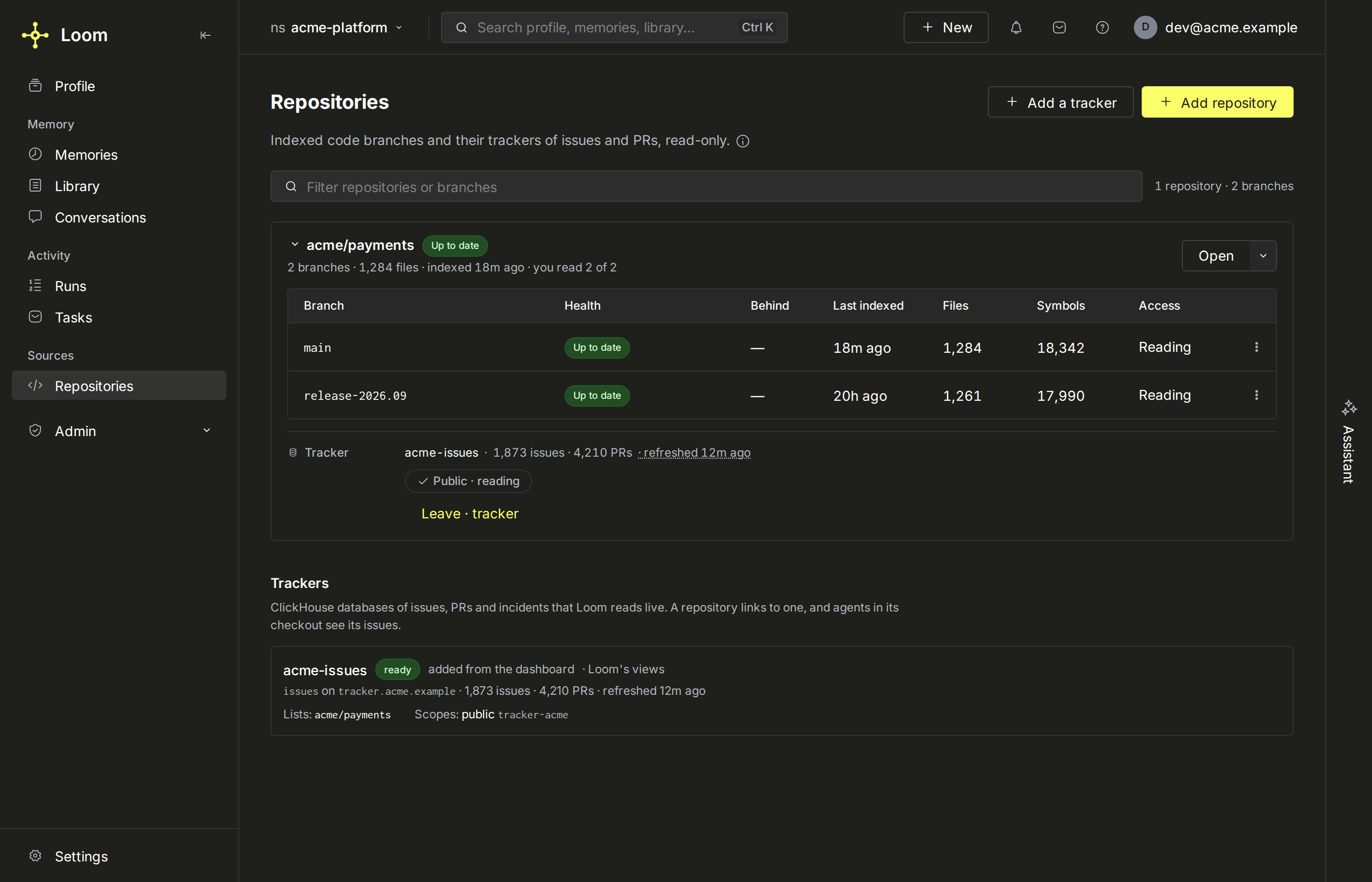
The code workers are off by default; a deployment turns them on per repository
(repositories). The default core MCP toolset lists no code tools
unless LOOM_MCP_CODE_TOOLS=true; ?toolset=coding always does.
Loom indexes git repositories into ClickHouse and answers structure questions through
the code.* operations: where a symbol is defined, who calls it, what a change
reaches, which merged PR touched a line. Agents call them over MCP, HTTP
(POST /v1/code.<op>) or the Python SDK (agent.code). Every agent reads the same
rows, so a repository is parsed and embedded once per merge, not once per session. How
the index is built is in
code index architecture.
What it answers
| You want to know | Ask |
|---|---|
| Where is the code that does X? | code.search, or code.ask for a cited answer |
| Where is this exact string, message or identifier? | code.grep (mode: "message" for a printed log line) |
What is Foo::bar, and what does its body say? |
code.symbol |
| Who calls it, and what does it call? | code.callers, code.callees |
| What does my change reach, and which tests must run? | code.impact, code.test_gate |
| Which merged PR touched this line, and what did reviewers say? | code.blame_range, code.history, code.review_brief |
| Does a PR like the one I am about to open already exist? | code.pr_check |
| Is the index current enough to answer? | code.index_status, the as_of block on every answer |
Every op, grouped by task, is on operations.md.
One namespace is one branch
A code namespace is one repository branch at one commit. Loom keeps a bare git mirror,
walks the branch's first-parent history, and stores what it extracts in loom.code_*
tables keyed by (org, namespace).
- Nothing is read from an agent's checkout. Uncommitted and unpushed changes are never in the index. A feature branch is indexed only when configured as its own entry.
- Each branch is its own namespace; branches of one repository share one mirror. "Is
this fix on the release branch?" is a question to that branch's namespace, or to
several at once (
code.grep mode=presence namespaces=[…]). - Names are
[a-z0-9-]:code-<repo>for the default branch,code-<repo>-<branch-slug>for others (code-myrepo-2-4). - A code namespace has
kind=code. It holds the repository's team file rules, written by its members, and its design decisions, and is hidden from memory pickers. Access follows the usual grant rules (identities and namespaces).
What the index holds, per namespace:
| Unit | Table | Produced by |
|---|---|---|
| files and their last parse | code_files |
fast tier |
| chunks (functions, class skeletons, file headers, doc sections) | code_chunks |
fast tier; embeddings also by code_embed_recovery |
| symbols (definitions, signatures, spans) | code_symbols |
fast tier and compiler tier |
| edges (calls, inherits, overrides, includes, …) | code_edges |
fast tier and compiler tier |
| test → code mapping | code_test_map |
code_graph_stats worker, loom code crossref, code_coverage_import |
| merged PRs, reviews, issues | code_pr_history, code_pr_reviews, code_gh_items |
code_pr_history worker |
| per-PR context packs | code_context_packs |
fast tier |
| watermarks and worker state | code_index_state |
every code worker |
| query traces and outcomes | code_search_trace, code_search_outcome |
every read op, code.outcome |
Two tiers
Structure is extracted twice. Each symbol and edge names its tier (tier: scip or
treesitter). Where both tiers hold the same row, the compiler row wins.
- Fast tier. The
code_ingestworker diffs the branch from its watermark to the mirror's fetched tip and re-parses changed files with tree-sitter and the language lanes. It writes chunks, symbols and a heuristic call graph: a call bound in the same file has confidence 1.0, through the enclosing class 0.8, by a repository-wide name match 0.6. A call it cannot bind is declined, not guessed. UntilLOOM_CODE_READY_EMBED_COVERAGE(0.95) of chunks carry a vector,code.searchanswers from its lexical legs and says so. - Compiler tier. SCIP indexes from
scip-clang(C/C++),scip-typescript,scip-pythonandscip-go, run by thecode_scip_*_deltaworkers, withcode_scip_fullseeding and re-indexing C/C++ entries (see code index operations). An external producer can upload withcode.scip_ingest. It gives exact call, override and inheritance edges. Its C/C++, Go and TypeScript steps execute the repository's own build code; they run inside the repository-job sandbox.
Why two: the fast tier is cheap, so a merge is searchable after one ingest pass. The compiler tier needs a build environment and trails. Serving both, labelled, gives an answer at once and an exact one when the compiler tier catches up.
Workers
| Worker | Default | Does |
|---|---|---|
code_ingest |
off | fast tier, per merge; builds self-service entries |
code_embed_recovery |
off | embeds chunks the ingest pass left unembedded |
code_pr_history |
off | merged PRs, reviews and issues from GitHub |
code_scip_delta, code_scip_{ts,py,go}_delta |
on | compiler-tier deltas per merge |
code_scip_apply |
off | applies staged SCIP deltas |
code_graph_stats |
off | weekly PageRank, degrees, the test map |
code_summary |
off | weekly LLM file and module summary cards |
code_backport_gaps |
on | nightly backport report; needs code_pr_history |
code_coverage_notify |
on | delivers code.coverage.watch events |
Settings and intervals are in the workers reference and the configuration reference.
Note: the extractor stamp. Rows are content-addressed, so an unchanged file re-ingests to the same rows even after the extractor code changes. A hash of the extractor modules and grammar versions (the stamp) closes that gap: when it moves,
code_ingestre-derives the affected stage for every file in that language family, in paced batches. A code change to an extractor module therefore re-indexes every repository on the next deploy; comments and docstrings are outside the stamp. Lane parsers outside the stamp (TypeScript, Rust, Go, Java, …) needloom code backfill --paths-fileinstead. An hourly reconciliation also re-ingests files whose rows predate their last change. Details: code index architecture.
Language support
A file's language comes from treesitter.lang_for_path (C/C++, Python, shell, SQL,
docs, config), then lang_detect.LANG_BY_EXTENSION for the lane languages, then
shebangs and shell detection. "Edges" are what code.callers / code.callees walk.
code.impact adds mapped tests and co-change partners, so a language without call edges
still gets file-level impact.
| Language (extensions) | Symbols | Fast-tier edges | Compiler tier |
|---|---|---|---|
C / C++ (.c, .cc, .cpp, .cxx, .h, .hpp, .hxx, .ipp, .inl) |
yes | calls, includes, inherits, overrides | scip-clang |
Python (.py, .pyi, .pyw, .ipynb code cells, python shebang) |
yes | calls, imports, inherits, overrides | scip-python |
TypeScript / JavaScript (.ts, .tsx, .mts, .cts, .js, .jsx, .mjs, .cjs) |
yes | calls (including new), imports, inherits, overrides |
scip-typescript |
| Vue, Svelte, Astro components | yes | as TypeScript / JavaScript, from the script block | — |
Angular component templates (.component.html) |
yes | the component as one unit | — |
Go (.go) |
yes | calls, inherits (interface embedding, structural implementation); SQL islands | scip-go |
Rust (.rs) |
yes | calls, use imports, inherits (trait impls) |
— |
Java (.java) |
yes | calls (imports bind names, no import edges); SQL islands | — |
Shell (.sh, .bash, .bats, shebang, rc files) |
yes | calls (commands), source includes |
— |
Prisma (.prisma) |
yes | model relations | — |
Protocol Buffers (.proto), FlatBuffers (.fbs) |
yes | imports, type uses | — |
Go templates and Helm charts (.tpl, .tmpl, .gotmpl, templated manifests) |
yes | template calls | — |
Terraform / HCL (.tf, .tfvars, .hcl), Kubernetes manifests |
yes | references (reads) |
— |
Jsonnet (.jsonnet, .libsonnet) |
yes | calls, imports | — |
TLA+ (.tla, TLC configs), CMake (CMakeLists.txt, .cmake) |
yes | includes; TLA+ operators; the CMake link graph | — |
Markdown and docs (.md, .mdc, .mdx, .rst, .html, .htm) |
sections (.md only) |
relative links, backticked names as reads to the code |
— |
SQL (.sql) |
with a switch | table references, with statement records on | — |
| Host files (Dockerfile, Makefile, Jenkinsfile, CI YAML) | with a switch | invoked scripts | — |
| Config, CSS and other text files | no | none; chunked for search and grep only | — |
Switches (all need a loom code backfill --paths-file of the affected tree when turned
on for an existing namespace):
| Setting | Default | Effect |
|---|---|---|
LOOM_CODE_SQL_STATEMENT_RECORDS |
off | .sql as statement records instead of line windows |
LOOM_CODE_PY_SQL_ISLANDS |
off | SQL inside Python becomes statements and table edges |
LOOM_CODE_SHELL_ISLANDS |
off | SQL strings in shell tests become statements |
LOOM_CODE_HOST_ISLANDS |
off | Dockerfile, Makefile, Jenkinsfile and CI YAML jobs become symbols |
code.coverage reports what one namespace holds per language and tier. Read it before
trusting callers or impact for a language. Adding a language:
adding language support.
How an agent uses it
flowchart LR
  Q["question in words"] --> S["code.search / code.ask"]
  G["exact string"] --> R["code.grep"]
  S --> Y["code.symbol"]
  R --> Y
  Y --> C["code.callers"]
  C --> I["code.impact (diff)"]
  I --> P["code.pr_check"]
P --> O["open the PR"]- Find.
code.searchfor a question in words,code.grepfor a string you hold. Each hit names its enclosing unit, so you rarely open the file. - Pin the symbol.
code.symbolreturns definition, signature, body, recent PRs and (withuses_brief: true) top call sites. - Walk the graph.
code.callerswithdepthhops. Readepistemicto know whether the list is exact or a lower bound. - Measure the change.
code.impactwithfilesor a unifieddiffreturns the touched symbols, the tests that reach them, andco_change_missing. - Check for a duplicate.
code.pr_check:verdictisduplicate_of,relatedornone(history-and-prs.md).
These are the ops the coding toolset lists. code.callees and code.test_gate are
callable by name or through loom_op. Report what you did with the hits through
code.outcome (every result carries a trace_run_id).
Clients:
- The Claude Code and Codex plugins (claude-code.md,
codex.md) resolve the checkout's remote to its code
namespace, send
X-Loom-Code-Scope: <org>/<namespace>, list?toolset=coding, and redirect whole-file reads and tree-wide greps in an indexed checkout to these ops. Files the session modified are read locally. - The
loom-codeskill (skills/loom-code/SKILL.md) is the routing guide for other Agent-Skills clients. - The grep shim annotates
grep/rgoutput with each hit's enclosing function. - In a pipeline, call the ops at fixed steps (triage, ownership, backport presence).
If you expose code.grep to your own model, pass as_of, abstain_code, note and
coverage_floor with the hits. A model that sees only matches cannot tell an empty
index from an empty repository.
Reading an answer
Every operation answers with its own typed schema, over HTTP and MCP alike, so an agent
reads fields rather than prose. A code.search answer, trimmed:
{
  "results": [
    {
      "path": "src/quota/limiter.cpp",
      "start_line": 412,
      "end_line": 468,
      "symbol": "acme::RequestLimiter::admit",
      "kind": "function",
      "description": "Charges a request against its tenant's window and rejects it once the quota is spent.",
      "tested": true,
      "next": "code.symbol name=acme::RequestLimiter::admit"
    }
  ],
  "next_cursor": "eyJjIjoiN2Q0…",
  "has_more": true,
  "abstain": false,
  "retrieval_risk": "low",
  "retrieval_confidence": 0.71,
  "as_of": { "branch": "main", "status": "fresh", "commit": "4be19c07a" },
  "trace_run_id": "8f0e2c41…"
}
code.symbol answers definitions with their signature and index tier; code.callers
answers call-graph edges with epistemic (exact or lower_bound) and its causes;
code.impact answers the affected symbols, tests and files; code.ask answers prose
inside a structured response with citations. The Python and TypeScript SDKs carry types
generated from the same schemas.
- Freshness. Every conversational answer carries
as_of. Gate onas_of.stale, not on whether the first build finished (freshness.md). -
abstain_codebefore the hits. An abstain is a statement about the question:abstain_codeMeaning Do ""answered read the results no_matchthe literal occurs in no indexed chunk in the scope sent widen the scope; check coverage_flooridentifier_absentthe identifier missed the symbol table and appears in no indexed chunk check the spelling and the branch not_coveredpath_prefixlies outside the indexed prefixes (notelists them)read locally pattern_too_broada code.search pattern=matched more thanLOOM_CODE_SEARCH_PATTERN_MAX_FILESfilesadd langs/path_globs/path_prefixbelow_threshold,low_calibrated_confidencenothing the search trusts for the question rephrase, or grep an identifier you hold off_domainno file of this namespace is near the question check the namespace
retrieval_risk(low,medium,high,abstain) is the search's calibrated confidence. Treathighas leads to verify.- Coverage is a floor.
coverage_floor: truemeans the index holds every chunk the chunker admitted, not every byte. Files overLOOM_CODE_INGEST_MAX_FILE_BYTES, vendored and generated trees, and excluded paths are absent. An empty grep does not prove absence. Apath_prefixnaming one file asks only that file. -
Structural ops answer with a verdict.
code.impact,code.outline(verdict) andcode.verify(index_verdict) say why an empty walk is empty:Verdict Meaning abstainno_indexed_pathsno path in the request declares anything (tests, data, config, docs) false no_seeds_in_hunksevery hunk falls outside every function false no_static_callersthe seeds resolved and nothing calls, inherits or overrides them false not_covereda source path the index does not hold true no_matchnothing resolved and the index cannot say why true The first three are answers; no fallback grep is needed.
epistemic.code.callersandcode.impactanswerexactwhen the compiler tier covers every seed file, no call site named like a seed was declined, and no override seed lacks its base. Otherwiselower_bound, withcauses:unresolved_calls,ambiguous_calls,dispatch_seeds_missing,treesitter_only_files,external_calls,ctor_edges_absent,scip_stale_files,truncated. History answers are alwayslower_bound. No static index sees dispatch through function pointers.- Enclosing unit. Grep hits carry
scope,scope_start_line,scope_end_line; search hits carrysymbol,start_line,end_line. - Literal cost. Literals are answered from a 3-gram index. A rare identifier is
cheap; a common word or a pattern under three characters touches most of the
namespace. Use the most specific token you hold, and
mode: "files"first on a broad one.
Limits
- Only merged code on configured branches. Your working tree is yours to grep.
- The fast-tier graph binds by name and declines ambiguous sites. Languages without a
compiler tier never answer
exact. - Open pull requests are not indexed.
pr_numberoncode.callers/code.impactoverlays one open PR's post-image when the mirror holds its head (git_fetch_pr_heads); those edges carry tieroverlay.
Troubleshooting
Start with code.index_status (watermarks, lags, tiers, worker errors) and
code.coverage (what the namespace holds).
| Symptom | Cause | Fix |
|---|---|---|
| a symbol you just added is not found | uncommitted, unpushed, or not yet ingested | grep your tree; code.index_status shows the lag |
lag_commits: 0 but merges are missing |
the mirror stopped fetching | clone_fetched_at / fetch_overdue, then /v1/admin/workers.status |
| a fix you know exists is not found | wrong branch namespace | code.grep mode=presence namespaces=[…] |
AUTH_INSUFFICIENT on every code.* call |
the token does not name the code namespace | join the repository, or mint with --namespaces |
| a call that names no namespace is refused | no X-Loom-Code-Scope header and no deployment default |
pass namespace, or set LOOM_CODE_ORG / LOOM_CODE_NAMESPACE |
| no code tools in the MCP list | the core toolset without LOOM_MCP_CODE_TOOLS=true |
mount ?toolset=coding, or set the flag |
code.search says lexical-only |
embedding coverage below LOOM_CODE_READY_EMBED_COVERAGE |
enable code_embed_recovery; watch embedding_coverage |
| callers look incomplete for a language | the language has only the fast tier | read epistemic / causes; code.coverage shows the scip column |
| every namespace re-indexing after a deploy | an extractor module changed (the stamp moved) | expected; progress is in code_index_state |
a self-service repository stuck in error |
clone or first index failed | read stage_detail on code.repos |
Operator signals (tier lag, stale files, failed passes) are in code index operations.
Related
- operations.md: every
code.*op by task - freshness.md:
as_of, commit coverage, CI refresh - repositories.md: adding a repository, branches, who can read
- history-and-prs.md: PR history, backports, bisect
- tracker/overview.md: issue, test and incident records linked to a repository
- operations reference: generated arguments